|
 =
=
 Driving in Croatia
/ Hrvatska
Driving in Croatia
/ Hrvatska
Key
rules, regulations and things to know
 [Croatia became the 28th EU member country
on 1 July 2013]
[Croatia became the 28th EU member country
on 1 July 2013]
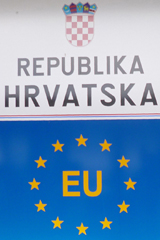 The "HR"
from Hrvatska is used un car registration plates
and Internet identity .hr Hrvatska is the Croatian
name of Croatia
The "HR"
from Hrvatska is used un car registration plates
and Internet identity .hr Hrvatska is the Croatian
name of Croatia
Driving: Drive
on the right and overtake on the
left.
 Speed
limits:
50km/h
cities/towns - 90km/h
open road- 110km/h
major roads - 130km/h
motorways
-
There is a minimum speed on motorways of 60km/h
Speed
limits:
50km/h
cities/towns - 90km/h
open road- 110km/h
major roads - 130km/h
motorways
-
There is a minimum speed on motorways of 60km/h
 Seat
Belts: All passengers must wear
seat belts and special "booster child" seats are required
for infants. Children under the age of 12 may not sit in the
front seat. Naturally as in so many countries a lot of taxi
drivers don't use them. They do save lives and taxi drivers
are professional drivers.
Seat
Belts: All passengers must wear
seat belts and special "booster child" seats are required
for infants. Children under the age of 12 may not sit in the
front seat. Naturally as in so many countries a lot of taxi
drivers don't use them. They do save lives and taxi drivers
are professional drivers.
 Mobile Phones: Mobile
phones are not permitted to be used whilst driving except for
hands-free systems.
Don't
risk using one as you can receive a heavy fine in most countries
and more important cause a serious accident.
Mobile Phones: Mobile
phones are not permitted to be used whilst driving except for
hands-free systems.
Don't
risk using one as you can receive a heavy fine in most countries
and more important cause a serious accident.
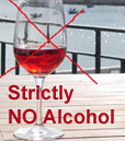 Drink and Driving:
Permitted
blood level of alcohol 0.00 - 0.05
- You must not drink and drive More
information Here
Drink and Driving:
Permitted
blood level of alcohol 0.00 - 0.05
- You must not drink and drive More
information Here
 Headlights:You
must drive with headlights on during daytime in winter from
the last Sunday in October to the last Sunday in March.
Headlights:You
must drive with headlights on during daytime in winter from
the last Sunday in October to the last Sunday in March.
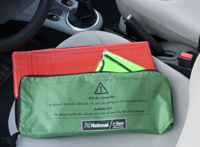 Safety Equipment:
It is obligatory to carry a fluorescent
vest in your car whilst driving in Croatia. You must
keep the vest in the car and not in the boot. You must wear
the vest whilst attending to a breakdown, e.g. changing a tyre.
Safety Equipment:
It is obligatory to carry a fluorescent
vest in your car whilst driving in Croatia. You must
keep the vest in the car and not in the boot. You must wear
the vest whilst attending to a breakdown, e.g. changing a tyre.
Drivers
Age: Drivers aged 24
or younger are subject to reduced speed limits of 10KPH less
than the standard limit.The
minimum driving age is 18.
Minimum
Driving Ages European Countries - Here
Check
with your car hire company the minimum and maximum age to rent
a car.
 Disabled Parking:
The
Blue Badge is recognised in all European countries
- More
information Here
Disabled Parking:
The
Blue Badge is recognised in all European countries
- More
information Here
 Hrvatski autoklub - (HAK) - To enter the site, click on the
image above left
Hrvatski autoklub - (HAK) - To enter the site, click on the
image above left
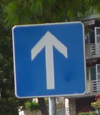
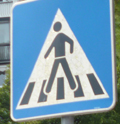
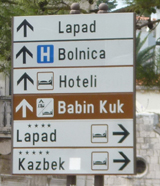
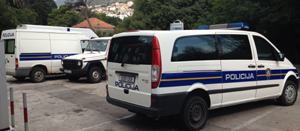
Back
to top
 Information from holiday autos about Croatia
Apparently
there a thousand islands in Croatia. No need to visit them all,
they’re just as pretty as one other. You’ll need car hire Croatia
though, driving through spectacular scenery is no fun on packed
bus. Book cheap Croatia car hire today.
car
hire in Dubrovnik
- Famed
for its city walls, Dubrovnik is a top spot for tourists using
car hire Croatia. See the city the way you want to see it with
cheap car hire. After taking in a tour of the city, drive over
the border into Montenegro. It’s a great day out and a brand
new country. For a spot of relaxation, take the hire car to
Cavtat. Make the most of Croatia car hire and hit the sandy
beaches, get a lilo and while the day away.
 Parking
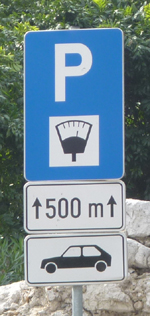
can be very difficult in Dubrovnik anywhere near the old city.
Parking
can be very difficult in Dubrovnik anywhere near the old city.
car
hire in Split -
Don’t be torn of what to do in Split. Book car hire Croatia
and see it all at your own pace. Into history? Make the short
drive in your car rental to the Diocletian Palace. It’s one
of the best preserved Roman buildings in the world. Fed up with
history? Head out to the fortified town of Omis. It’s looming
hills will knock your socks off.
car
hire in Pula -Pula
has a distinctive Roman feel to it. Hire a car for a trip back
in time. Road signs, handily, are written in Croatian and Italian,
not English. Step into Spartacus's shoes at the amphitheatre
in Flavijevska. There's no lions to fight but head down to their
old cages and you'll feel just like a gladiator. After working
up a sweat, take the hire car to Kotli. The waterfall there
will soon have you refreshed and raring to go again.
top
driving tips - Headlights
should be turned on at all times - All motorways in Croatia
carry a toll -Police checks are common. Don’t take it personally.
See
also UK's Foreign and Commonwealth Page on Croatia
Back
to top
 FACT FILE — CROATIA:
Croatia
is a Central European and Mediterranean
country, bordering Slovenia in the west, Hungary in the north,
Serbia in the east and Bosnia and Herzegovina in the south.
Croatia also has a long maritime border with Italy in the Adriatic
Sea. These borders total 2,028 km altogether.
The
country is an interesting shape that is similar to a croissant.
The shape of the country comes about as a result of five centuries
of expansion by the Ottoman (Turkish) empire towards Central
Europe (although Croatia was never conquered by the Turks).
Size
– Main Cities & Language: Croatia
covers a land area of 56,691 square kilometres and has a population
of about 4.4 million people (2001 census). Over 90% of the population
is Croat (the majority of whom are Roman Catholics), but there
are also Serbian, Bosnian, Hungarian and Italian minorities.
The main population centres are Zagreb,
the capital (with a population of just under 800,000), Osijek
in the northwest, and the ports of Rijeka, and Split in the
south. The official language is Croatian, which is written in
the Latin script. Dubrovnik
is a top spot for tourists.
Croatia
has 5,835km of coastline, 4,057km of which belongs to islands,
cliffs and reefs. There are 1,185 islands in the Adriatic, but
only about 50 are populated. The largest island is Krk
(near Rijeka) which has a land area of 462 square km.
Climate:
The climate is Mediterranean along the Adriatic coast, that
means there are warm dry summers and mild winters, with 2,600
hours of sunlight on average yearly — it is one of the sunniest
coastlines in Europe! In the interior of the country, the climate
is continental with hot summers and cold, snowy winters.
History:
Slavic Croatian tribes settled in the area in the early 7th
century (arriving from present day Poland), accepting Christianity
in around 800 A.D., and soon establishing their own state ruled
by princes or dukes. In 925, Croatia became a kingdom under
the rule of King Tomislav. In 1102 the country formed a union
with Hungary which lasted until 1918. After the end of the First
World War, Croatia joined Serbia, and Yugoslavia (the land of
South Slavs) was formed, until its demise in 1991. The first
Yugoslavia (1918-1941) was ruled by the Serbian royal family,
Karadjordjevic, which naturally favoured the Serbs and caused
enormous resentment in Croatia.
The
country was invaded by Nazi Germany in April 1941, which gave
Croatia independence under the fascist dictator Ante Pavelic.
This regime was known for its harsh rule and for committing
numerous atrocities, and therefore many Croats (over 200,000)
actively joined the resistance movement under Tito which liberated
the country in May 1945. (Winston Churchill was so impressed
with the Croatian resistance that in 1944 he sent his son Randolph
and the writer Evelyn Waugh to Croatia as his personal emissaries.)
Croatia
became one of the Yugoslav republics
ruled by the communist government until 1991 when Croatia declared
its independence, prompting Serbian invasion. Almost all Croats
rose to defend their country under the leadership of its first
president, the late Franjo Tudjman (who died in December 1999),
and after five years the country was liberated. The country
is now a democratic parliamentary country.
How
to enter Croatia: Most of the visitors are usually from
the neighbouring countries of Austria, Slovenia, Italy, Germany
and so on, so they usually travel by car. From northern Europe,
the easiest way to get to Croatia would be to drive to Munich
and then enter Austria, down to Graz, cross into Slovenia, and
then head for Croatia which is signposted as soon as you leave
Maribor. For those travelling by air, the main airports are
Zagreb, Pula, Split, Dubrovnik and Rijeka Airport(which is on
the nearby island of Krk .
Entry
Requirements:
Foreign visitors do not normally require visas to enter the
country. If you need to check if you require a visa, contact
the Croatian Ministry of Foreign Affairs or the Croatian Embassy
in your country.
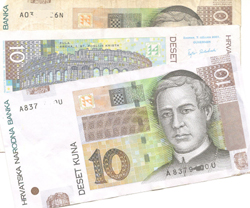 Currency — Money:
- The
Croatian currency is the Kuna, which is divided into 100 lipas.
The word "Kuna" means marten, a weasel-like animal, whose fur
Croats used for payment many centuries ago. The lipa is a lime
tree. ATMs are readily available in all resorts, towns and cities
in Croatia, in banks, supermarkets, airports and elsewhere.
Euros are accepted in many tourist attractions now.
Please note as the Kuna is a closed currency
you might be able to obtain some before visiting, but you need
to change them back before leaving the country or end up spending
money in the airport shops.
Currency — Money:
- The
Croatian currency is the Kuna, which is divided into 100 lipas.
The word "Kuna" means marten, a weasel-like animal, whose fur
Croats used for payment many centuries ago. The lipa is a lime
tree. ATMs are readily available in all resorts, towns and cities
in Croatia, in banks, supermarkets, airports and elsewhere.
Euros are accepted in many tourist attractions now.
Please note as the Kuna is a closed currency
you might be able to obtain some before visiting, but you need
to change them back before leaving the country or end up spending
money in the airport shops.
UPDATE
JANUARY 2023 - Croatia has joined the € Euro
Health
& Insurance: The health service is of a good standard.
You have to pay for seeing a doctor or being treated in a hospital.
Certain countries, such as Britain, have reciprocal medical
arrangements whereby, in principal, you should not have to pay
for any emergency treatment. It is advisable to take out a personal
medical insurance and
travel insurance
Food
& Drink: You will get the standard fare as in many other
central European or Mediterranean countries (pizza, pasta, meat
dishes, fish). All food is safe to eat as restaurants are regularly
inspected, and there is no problem with drinking water. Unsurprisingly
seafood is a speciality along the Croatian coastline. Croatian
beers are of a high quality like Zagreb's Ozujsko pivo or Karlovacko
pivo or Tuborg, brewed under license in Croatia. In Dalmatia,
some red wines such as Faros or Dingac are exquisite. You should
also try Croatia's favourite brandy sljivovica, made from plums,
or travarica, a herbal brandy.
Electricity
is 220V, 50Hz. Croatia uses the standard European 2 point plugs.
Speed & Measurement: The system is metric.
Telephone Country Code: + 385

Source
jmlvillas.com
- (some of this information has been provided
by jmlvillas.com clients)
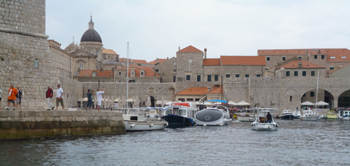
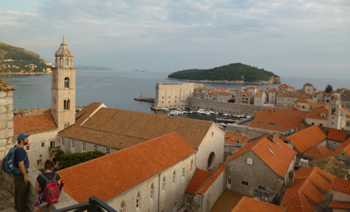
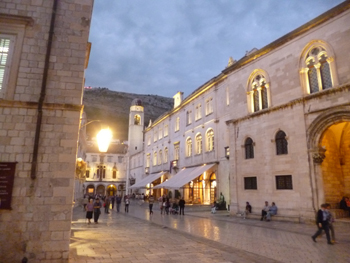 Views of Dubrovnik
See
also Visit Croatia for further information about the country
and staying there
Back
to top
Emergency
Telephone number: pan-EU Emergency
112 Can be used in all EU Countries and
it can be dialled from a locked mobile or a mobile with
no sim card. We have driving guides for those countries
marked in red below (plus
other non EU member European countries).
Austria
-
Belgium
-
Bulgaria - Cyprus
- Czech
Republic - Denmark
- Estonia - Finland
- France
- Germany
-
Greece - Hungary
- Ireland
- Italy
- Latvia - Lithuania - Luxembourg
- Malta-
Netherlands
- Poland
- Portugal
- Romania - Slovakia - Slovenia
- Spain
- Sweden
Back
to top
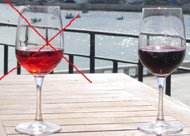 Drink Drive Laws - Examples of what can be drunk at
present
Drink Drive Laws - Examples of what can be drunk at
present
It
is not a lot and in some countries even to drink the
glass on the right would be breaking the law if you
drove afterwards in others a sip would be too much see
"Wine"
below
"Wine
- even a sip will send you
over the limit and invalidate your insurance in Parkistan,
Cuba, Indonesia, Romania, Jordan and Nigeria, according
to Rhinocarhire.com which produces a comprehensive guide."
The
A to Z of car hire - The Independent - August 2010
See
this guide for further information
Back
to top
Emergency
Telephone Numbers in Europe:
Emergency
Telephone number: pan-EU Emergency 112 Can be used
in all EU Countries and it can be dialled from a
locked mobile or a mobile with no sim card.
Driving
abroad - British Government website.
Contains general information
about driving abroad and gives you the option to search
for specific advice by country
Finally,
Don’t forget your excess cover and buy it before you
set off
Back
to top

| 











 Driving
in
Austria
Driving
in
Austria Driving
in
Belgium
Driving
in
Belgium Driving
in
Bulgaria
Driving
in
Bulgaria Driving
in
Canada
Driving
in
Canada Driving
in
Cyprus
Driving
in
Cyprus Driving
in
The
Czech
Republic
Driving
in
The
Czech
Republic Driving
in
Denmark
Driving
in
Denmark Driving
in
England
Driving
in
England

 Driving
in
Finland
Driving
in
Finland Driving
in
France
and
Corscia
Driving
in
France
and
Corscia Driving
in
Germany
Driving
in
Germany
 Driving
in
Greece
and
the
Greek
Islands
Driving
in
Greece
and
the
Greek
Islands Driving
in
Holland
Driving
in
Holland Driving
in
Hungary
Driving
in
Hungary Driving
in
Iceland
Driving
in
Iceland Driving
in
Ireland
Driving
in
Ireland